
Typewriters of Cate
October 1, 2026
A half-dozen midcentury typewriters have been placed around Cate to engage students and help them tend to the present moment.
By Evan Pondel
Interim Senior Communications Offiicer
The typewriter, in many respects, is a decommissioned robot.
Once an indispensable machine that helped humankind transfer ideas into tangible, tactile prose, the typewriter has mostly been demoted to scrap metal.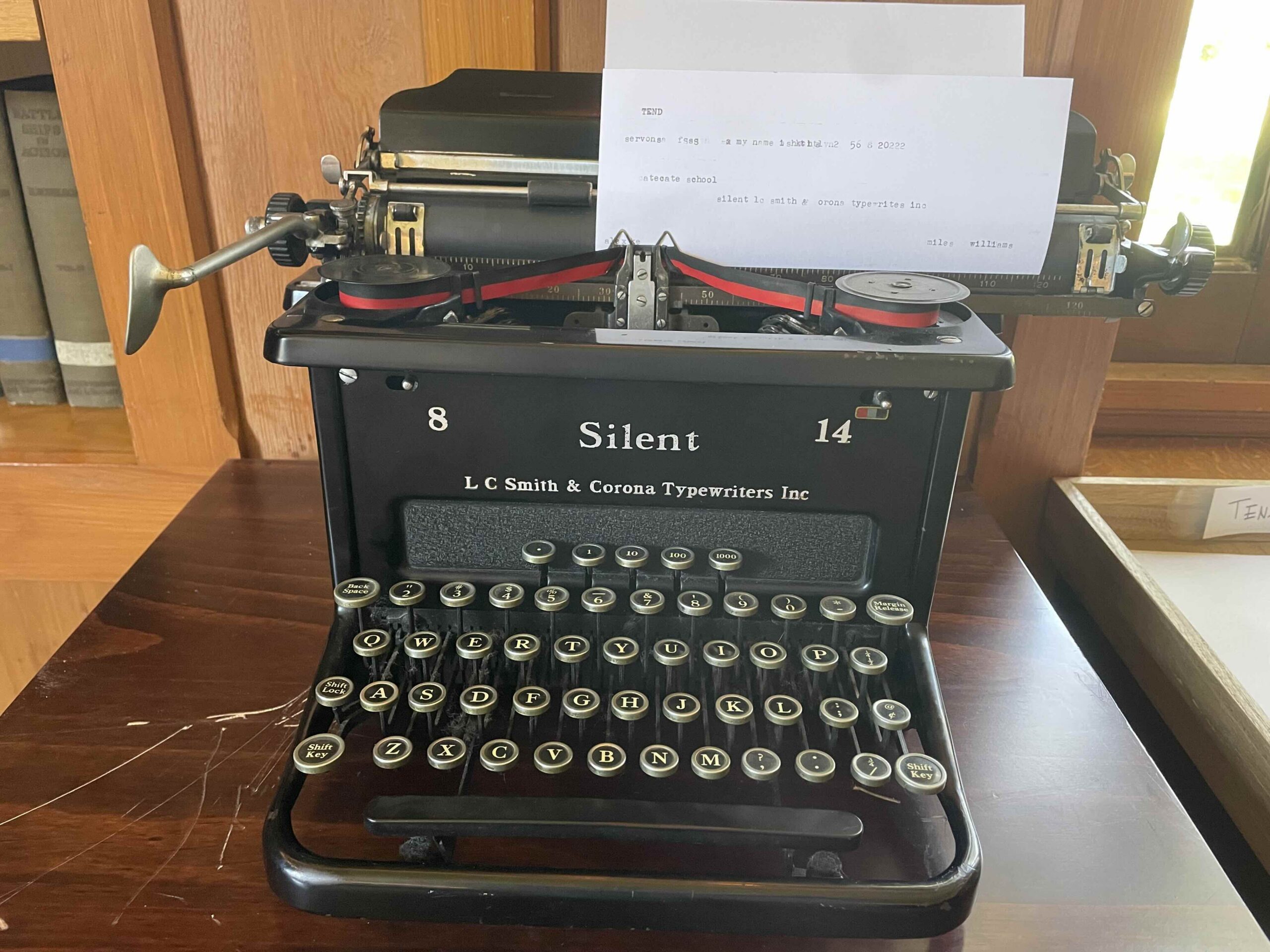
Its fate is reminiscent of Cate’s summer reading of “Monk and Robot,” which explores the complicated relationship between humans and technology.
Much like the robots in the book, typewriters have withdrawn from human society.
And yet, when you encounter a well-oiled typewriter, its grasshopper arms rising to the occasion to eventually make an imprint on pressed pulp, there is a shock of satisfaction and connection. Eureka!
Meet the typewriters of Cate: Gertrude, Eleanor, H.D., Clarissa, Hypatia, and E.E. They are all living in different places and spaces throughout campus, freshly tuned and ready to receive ideas from anyone who would like to tend to the present moment.
Eleanor is taking up residence in Johnson Library. Clarissa is settling into College Counseling. H.D. can be found in McBean Library. Gertrude is in the McIntosh Room, and Hypatia is posted up in the Mathematics Building. The others are awaiting their assignments.
The typewriters were donated to Cate by Santa Barbara urban planner Simon Kiefer. For nearly a decade, Kiefer ran workshops throughout the region, enlisting typewriters to teach creative writing and graphic design. He often encouraged students to unlock the scroll release and strike the same key repeatedly, creating waves of letters.
“Typewriters help us connect our minds to a creative process that is fading with the rise of artificial intelligence and large language models,” Kiefer said. “They’re an important reminder on how to tend to a moment with intention.”
Many of the typewriters Kiefer donated are midcentury machines, carrying themselves with an undeniable sense of dignity and a certain allegiance to ink ribbons. They also require a hefty strike, usually from an index finger, to ensure a key, a thought, an intention leaves its mark.
The Mesa is home to other typewriters, including one that Ben Elkin ’27 recently rescued while birdwatching in the Carpinteria salt marshes.
“I literally found it in the woods,” he said. “There’s like a 75% chance it’s haunted.”
Among other typewriters of the Mesa is Katharine “Kate” Cate’s Remington Model Seven. It’s still in working order and recently serviced by Wayne Lokan, one of the last typewriter mechanics in Santa Barbara.
When Lokan saw Kate’s typewriter, his eyes widened and a smile spread across his face.
“That’s one great machine in really good condition considering how much time has passed,” he said. “It doesn’t need much maintenance. Maybe a little oil. The more someone uses it, the better it works.”
After Lokan serviced Kate’s typewriter, Head of School Alex Lockett used it carefully to type the following on an index card: “I’ve been thinking about voice. Specifically, about the Latin word: Vox. Vox speaks to something essential about voice, the divine. We each have the chance to use our voice in a divine way to call forth something only we could say. May these typewriters be an expression of our commitment to honoring Vox in a new, yet timeless form.”